
Spring 2026 belongs to Kalamkari — Andhra Pradesh’s hand-painted cotton narrative-cloth, traced in tamarind-twig pen and madder dye like a bedtime story whispered into mulmul.
There is a softness to a piece of cloth that has been drawn upon rather than printed. You can feel it in the hand the moment you lift it — a faint hesitation in the line, a place where the dye has bled half a hair too far into the cotton, a whisper of a peacock’s tail-feather whose tip is just slightly thicker than its twin. That is the gentle inheritance of Kalamkari: the seven-hundred-year-old hand-painted narrative-cloth of Andhra Pradesh, drawn in tamarind-twig pens by women whose mothers and grandmothers drew the very same lotus, the very same tree-of-life, the very same Garuda mid-flight across the same length of mulmul cotton. And this Spring 2026, after a long, quiet pause, the pen is in our hands again.
The word itself is honey. Kalam — pen. Kari — work. Pen-work. It is the kind of textile that began on temple walls in Sri Kalahasti, where storytellers traveled from village to village unrolling long painted scrolls and singing the Mahabharata into the dusk. It is the kind of cloth that was later refined in Machilipatnam for the Persian and Mughal courts, who wanted lotus medallions and cypress trees instead of gods. It is the kind of fabric whose colors come not from a chemistry lab but from a tamarind seed, a pomegranate rind, an iron filing rusted in jaggery water, a bowl of fermented buffalo milk that fixes the pigment to the cotton like a vow. There is nothing about Kalamkari that is fast. And that is precisely why we love it.
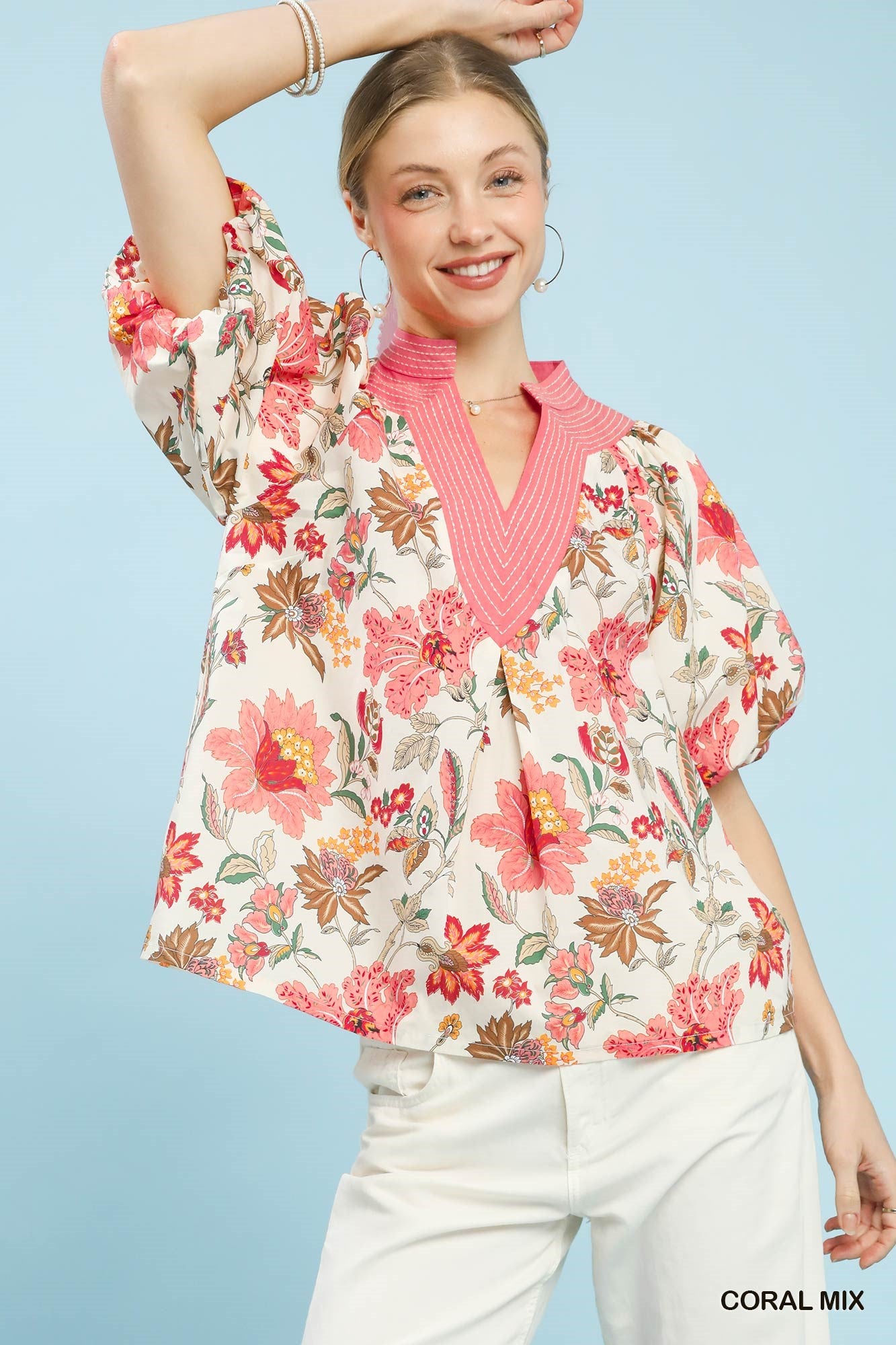
What does the Kalamkari woman wear in April? She wears a soft floral blouse with a faint hand-drawn quality — puff-sleeved, ditsy-printed, the kind of top whose tiny inked petals look like they were brushed on at a courtyard table beside a brass dye-pot. She wears it loose over white linen pants. She knots a Kalamkari scarf around her wrist as a slow bracelet. She lets her hair air-dry in two long ropes. She walks to the market in the warm orange end of the afternoon and buys a single mango.
The palette of this trend is the palette of the Krishna River at dusk: madder red, indigo blue, turmeric yellow, iron-black, undyed cream. Pair it with terracotta jewelry and your wrists begin to look like the temple wall at Lepakshi. For days at the water, slip into the romantic ruched sweetheart of the Honeymoon Top, whose soft cream cup feels like the unprinted ground of a Kalamkari panel waiting to be drawn upon — and let the inked sarong you tie at the hip do the storytelling. There is a reason the Coromandel painters left so much white space. There is a reason your skin is meant to be part of the picture.
Let your ankle catch the same gentle line. The Moon Dancer 3mm Anklet is a single thread of silver that sits below the cuff of a wide Kalamkari trouser like the faint pen-line a Sri Kalahasti artist draws to mark where the indigo will pool. It is the smallest piece of jewelry in the box and yet, somehow, the one your friends notice first. A pen-stroke. A footnote. A whispered punctuation mark. Slip it on with bare feet and a hem that drags through warm grass.
Even the way you carry your phone can echo the painted cloth. The Cosmic Tides phone case hums with the same swirling indigo dusk that Andhra Pradesh dye-masters chase when the iron-black outline is still wet. Tucked into a woven straw bag beside your sunglasses and a folded scarf, it becomes a small narrative panel of its own — a portable kalam of the modern girl.
And then the styling notes, gently. Kalamkari loves contrast: a hand-painted cotton scarf knotted at the throat of a plain white shirt-dress; a single Kalamkari panel sewn as a yoke onto an otherwise simple linen tunic; a strip of madder-red printed cotton wrapped twice around a straw hat brim. The point is never to over-dress. The point is to let one painted thing speak — to give it room — to let the rest of your outfit be the cream-colored ground beneath the pen.
Slow fashion, the kind woven and painted and stitched by the patient hand of a grandmother in a courtyard, is not a trend. It is a philosophy of dressing that asks us to consider where our beauty came from. To hold up a sleeve to the sun and trace the tiny brushstroke of a peacock-eye and think: someone drew this. someone, somewhere, dipped a tamarind twig into a clay bowl and drew this for me. That is the gift of Spring 2026.
If you would like to begin your own Kalamkari chapter — or simply find a softer, more story-rich way to dress this season — the curation we have gathered for you at Soul Flow Apparel is waiting. Pour a cup of cardamom tea, settle in, and browse the new arrivals the way you would unroll a long painted scroll across a verandah floor. There is a piece in there with your name already drawn on it, in tamarind ink, in a hand that is not yours and not mine, but very, very kind.
DONE: C:/Users/Techie Buddy/Desktop/Agents/Soul Flow/soul-flow/src/content/blog/2026-04-25-084502-post.md
Soul Flow Apparel
Shop the Story
Hand-picked pieces from Soul Flow Apparel to bring the look home.