
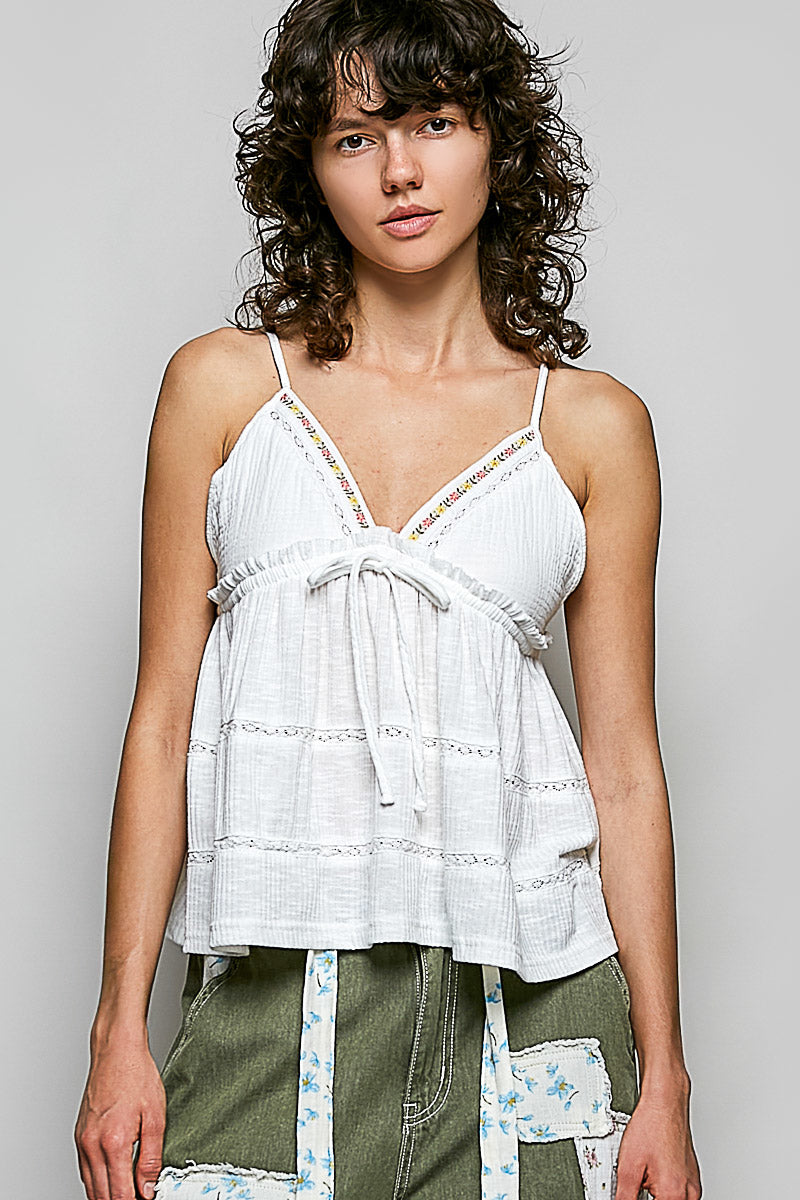
Spring 2026 is falling in love with chikankari — Lucknow’s whisper-soft white-on-white embroidery — and the breezy boho silhouettes that wear it like a heirloom love letter.
There is a particular kind of magic that lives inside a piece of chikankari cloth — a hush, almost — that you don’t quite hear so much as feel against your collarbone the moment you slip it on. It is the magic of white thread, drawn through white cotton, by a woman sitting cross-legged in a Lucknow courtyard with a brass bowl of jasmine cooling beside her wooden hoop. She is making shadows out of stitches. She is making lace out of breath. And come spring 2026, that quiet, ivory-on-ivory poetry is the most romantic thing a boho woman can wear.
Chikankari (pronounced chick-an-kaa-ree) is the centuries-old embroidery tradition of Awadh — the pearl-and-rosewater region around Lucknow, in northern India, where Mughal queens once commissioned veils so fine they could be drawn through a wedding ring. The work is done entirely by hand, in white untwisted silk-cotton floss, on the softest possible mulmul, voile, or georgette. There are thirty-six recognized stitches in the chikankari vocabulary — the tepchi running line, the bakhiya shadow-work that lives on the underside of the cloth and shines through like a moon behind a curtain, the phanda and murri knots that bloom into tiny grains of rice, and the jaali net-work where the embroiderer pulls the warp and weft apart with her needle to make a window of woven air. None of it is printed. None of it is digitized. Every flower is a heartbeat in thread.
And it is exactly the mood spring is asking us to dress in.
After three seasons of loud color and maximalist print, the runways from Copenhagen to Jaipur are pivoting toward what stylists are quietly calling “breath dressing” — clothing so light, so pale, so softly handworked that it feels less like an outfit and more like a state of mind. Think jasmine, milk, conch-shell, oyster, the inside of a magnolia petal. Think the way a verandah curtain lifts in a 6 a.m. breeze. That is the chikankari mood, and it pairs effortlessly with everything a boho wardrobe already loves: low-slung linen trousers, layered mother-of-pearl pendants, ankle stacks of cord and crystal, sun-bleached straw totes, and bare, sandalled feet on warm stone.
Start with the heart of the look — a tonal embroidered cami that does the talking before you even finish your sentence. The POL V-Neck Embroidered Trim Ruffled Cami carries that exact whisper of hand-finished trim around the neckline, the kind of detail that catches the light like a half-remembered lullaby. Tuck it loose into wide trousers, leave it untucked over a swim bottom, layer it under a half-buttoned linen shirt — chikankari spirit lives in restraint, not fuss.
Then there is the linen layer that does ninety percent of the styling work for you. The Umgee Linen V-Neck Flutter Sleeve Top is the modern western cousin of the Awadhi kurti — same airy soul, same flutter at the upper arm, same gentle V at the throat where a single strand of seed pearls would sit perfectly. In a chalk-soft palette it becomes the exact backdrop that chikankari romance was made for. Wear it with rolled jeans for the farmer’s market. Wear it with a slip skirt for a candlelit garden dinner. Wear it with a kimono and call yourself a poem.
If you want a touch more drama — the kind of soft-focus drama that belongs in a slow-pan film scene at dawn — reach for the POL Tied Ruffled V-Neck Short Sleeve Blouse with Lace Detail. Lace and chikankari speak the same dialect of hand-finished tenderness. The little tie at the bust, the ruffled collarbone, the soft V — it’s the Awadhi-courtyard romance translated into something you can throw on with denim cutoffs and gold hoops on a Saturday morning.
And you cannot — cannot — talk about whisper-fine boho dressing without inviting in the trousers that float. The Sahara Harem Pants drape the way a Lucknavi gharara drapes — gathered, breathing, moving like incense smoke around your ankles. Pair them with any of the embroidered tops above, add an anklet stack and a stack of tiny brass bangles, and you’ve built an outfit that looks effortless and feels like a held breath.
The whole chikankari mood is about being seen softly. Not loud. Not curated to the millimeter. Just luminous, hand-touched, and quietly certain of itself — the way the most beautiful women you’ve ever met always seem to be.
Come step into the spring whisper with us. Browse the full bohemian collection at Soul Flow Apparel, light a stick of jasmine, and let your wardrobe start humming a softer song.
Soul Flow Apparel
Shop the Story
Hand-picked pieces from Soul Flow Apparel to bring the look home.